

Monthly Safety Scenario (MSS)
The Monthly Safety Scenario (MSS) is a Loss Prevention initiative to assist members in their efforts to comply with international safety regulations and to follow best practices.
The Club is publishing, every month, a new Monthly Safety Scenario (MSS) to assist owners in their efforts to comply with the above regulations. Alternative scenarios will be uploaded in SCOL. It is easy to download the MSS and enter the written conclusions from the meeting and send feedback to the shore-based organisation.
Right-click on the link below and select “Save target as…“ to save the pdf file on your computer.
MSS Case January: Lack of insulation caused fatal fire in the engine room
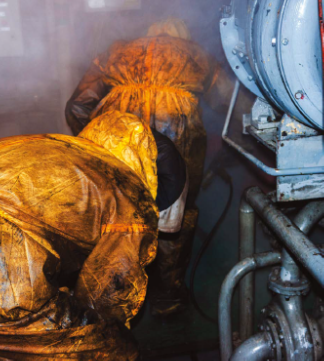
The vessel was sailing smoothly in open sea towards the next port, in fine weather. Two weeks earlier the engineers had removed a section of the fuel pump pipe, which was in poor condition. They only carried out a quick visual inspection, assuming that the rest of the pipe was in good condition. Unfortunately, cracks on the pipe, concealed by dirt and oil, went unnoticed.
Below the cracked fuel pipe there was another fuel pipe, which had damaged insulation, exposing the pipe, and providing no protection.
It was morning and an oiler was carrying out his rounds.
When he approached the main engine he could see smoke and flames close to the fuel pumps by the main engine. There was an explosion with fire spreading fast and it was soon out of control. The fire alarms sounded but the automatic hi-fog system did not start.
This was because the hi-fog system was set to manual instead of automatic, deviating from the vessel’s SMS.
The Second Engineer and the motorman, who were in the engine workshop at the time of the explosion, could not escape without entering the engine room, as there was no separate emergency escape route from the workshop. Running past the spreading fire, they made their way to the exit.
Black smoke was spreading throughout the engine room and they could see the Chief Engineer running in the opposite direction to help the oiler who had passed out near the fire. The Chief Engineer shouted that he was right behind them and that they should escape and start the hi-fog system.
The Second Engineer and motorman reached the emergency escape in the aft part of the engine room. Suffering from heat injuries and smoke inhalation they climbed the ladder, at which point the vessel blacked out. The main and auxiliary engines had stopped. The emergency generator kicked in, but shortly afterwards it too stopped, as the fire dampers to the emergency generator room had failed and closed, delivering insufficient air. This resulted in loss of power to the emergency switchboard with fire water pumps and other electrical equipment becoming inoperative.
At this time the air supply and fuel supply had not been stopped. It was the Chief Engineer’s duty to shut them off but he was still in the engine room. All crew mustered but the Chief Engineer and oiler were still missing. The Master ordered the fire teams to suit up
and enter the engine room to locate the missing engineers. He also ordered the fire dampers to be opened for the emergency generator room.
The Master would not release the CO2 until the engineers had been accounted for. He ordered the engine room fire dampers to be closed and the ventilation to be stopped from the remote control station outside the machinery spaces.
Shortly after the fire team had entered the engine room the Second Engineer managed to start the emergency generator and the hi-fog system. They located the missing engineers who had been seriously burned and were lifeless, they were removed from the engine room and the CO2 system was started.
The Chief Engineer and oiler had suffocated. The fire was eventually extinguished.
Review the questions with your team in the latest Monthly Safety Scenario.
Under the ISM requirement, owners are obliged to carry out monthly safety meetings or safety committee meetings onboard their vessels. This obligation stems from Chapter 5 of the ISM Code: “Master’s responsibility and authority” and furthermore from “5.1.2, motivating the crew in the observation of that policy”.
The obligation can also be derived from the Code of “Safe Working Practices for Merchant Seamen”, where it is stated that the safety committee should meet regularly: “3.13.2, The frequency of meetings will be determined by circumstances but as a general guideline, the committee should meet about every 4-6 weeks”.
For more Loss Prevention information, please contact:

Joakim Enström
Scenarios archive
(older scenarios are available in SCOL)